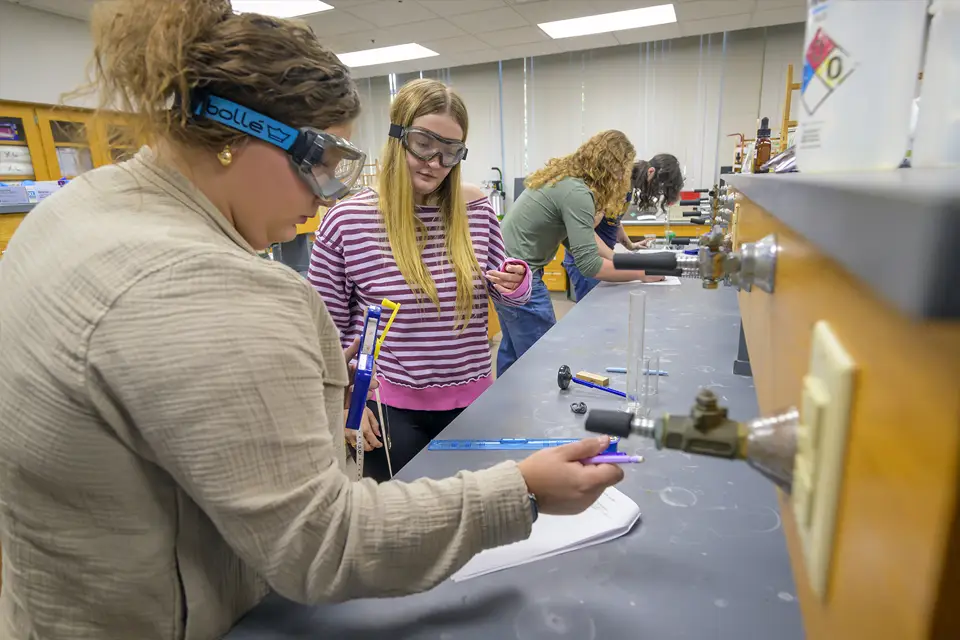

Chemistry students in class
Overview

Associate Degree in Chemistry at Northeast State

If you are interested in a career in research, medicine, pharmaceuticals or education, a chemistry degree at Northeast State gives you the academic foundation to get there.

Through the Chemistry Associate of Science (AS) on the Tennessee Transfer Pathway, you will complete rigorous coursework in general chemistry, organic chemistry, college calculus, and calculus-based physics that prepares you to transfer to a four-year university and continue toward a bachelor’s degree.

Northeast State’s chemistry major is designed for students who want a strong science and mathematics background before transferring. You will study in small class settings with dedicated faculty who are accessible and focused on your academic progress. Whether you plan to pursue graduate-level research, apply to medical or pharmacy school, or teach at the secondary level, this associate degree in chemistry provides a competitive start at a fraction of the cost of a four-year institution.

Program Options
Associate of Science (AS) – Tennessee Transfer Pathway · Certificate
Credit Hours
65
Average Time to Completion
Approx. 2 years (full-time)
Program Location
On-campus
Program Start
Fall (preferred)
Application Deadline
Varies by degree type
Why Northeast State

Why Choose Northeast State for a Chemistry Degree?

At Northeast State, the Chemistry program gives you a focused academic experience that prioritizes hands-on lab work, one-on-one faculty support and the coursework you need to transfer with a strong transcript. Rather than competing for attention in large lecture halls, you will learn general chemistry and all subsequent courses in an environment where your professors know your name and your academic goals.

4 reasons making your Northeast State experience stand out

A Curriculum Built for Transfer Success

The chemistry degree follows the Tennessee Transfer Pathway, which means your courses are designed to transfer directly to the University of Tennessee and Tennessee Board of Regents four-year institutions. You will complete 65 credit hours of coursework, including general chemistry, organic chemistry, college calculus, and calculus-based physics, knowing that your credits apply toward a bachelor’s degree without delays or redundancy.

Rigorous Science and Math Preparation

Is chemistry hard? The coursework is demanding, but Northeast State’s chemistry major requirements include the foundational lab experience and faculty support that help you handle upper-division courses at a four-year school. You will take two semesters each of general chemistry, organic chemistry and physics, along with Calculus I and II, building the scientific and mathematical skills you need to succeed at the bachelor’s level and beyond.

Faculty Who Are Invested in Your Progress

You will learn from faculty who bring professional and academic expertise to every course. At Northeast State, your chemistry professors are actively engaged in helping you understand the material, prepare for exams and plan your transfer to a four-year institution. With smaller class sizes, you get direct access to the instruction and mentorship that make a real difference in rigorous STEM coursework.

An Affordable Start to Your Chemistry Degree

Starting your chemistry degree at a community college allows you to complete your general education and foundational science courses at a fraction of the cost of a four-year university. With programs such as Tennessee Promise and Tennessee Reconnect, you may be able to cover tuition and fees entirely, reducing the financial burden of your overall education.

Northeast State By the Numbers

Be Part of Our College-wide Community

94% Job Placement Rate
32% First-Generation Students
$636k Scholarships Awarded
Coursework

What You Will Study in an Associate Degree in Chemistry at Northeast State

If you have been searching for chemistry classes near me, Northeast State offers all the required coursework on campus at the Blountville location, where you will have access to laboratory facilities and faculty support throughout the program.

The chemistry major requirements at Northeast State combine laboratory science courses with mathematics and a well-rounded general education core. Over four semesters, you will progress from introductory general chemistry and college calculus through organic chemistry and calculus-based physics, with each course building on the one before it. The curriculum also includes English composition, history, humanities, behavioral and social sciences and communication courses that fulfill the general education requirements for your transfer institution.

View Chemistry Program Curriculum

Core Chemistry and Science Courses

General Chemistry I & II

(CHEM 1110 · CHEM 1120)

Introduces the principles of chemistry, including atomic structure, chemical bonding, stoichiometry, thermodynamics and equilibrium. These courses establish the scientific foundation for all upper-level coursework in the associate degree in chemistry.

Organic Chemistry I & II

(CHEM 2010 · CHEM 2020)

Covers the structure, properties and reactions of carbon-based compounds. You will study reaction mechanisms, spectroscopy and synthesis techniques used in pharmaceutical, medical and research applications.

Calculus-Based Physics I & II

(PHYS 2110 · PHYS 2120)

Applies calculus to the study of mechanics, thermodynamics, electricity, magnetism and optics. For specific concentrations in chemistry at four-year institutions, calculus-based physics may be required.

Mathematics Requirements

Calculus I & II

(MATH 1910 · MATH 1920)

Covers limits, derivatives, integrals, and series. College calculus is a required component of the chemistry degree and supports your work in calculus-based physics and upper-level science courses after transfer.

Transferring?

We provide personalized support.

Northeast State makes it easy to take the next step toward a bachelor's degree. Through established transfer pathways, Tennessee Transfer Pathways and articulation agreements with colleges and universities across the region, students can transfer credits with confidence and continue their education without losing momentum. Whether you're earning an associate degree or completing general education requirements, our transfer advisor provides the guidance, resources and personalized support you need to achieve a smooth and successful transfer.

Transfer Info

Student Success

Chemistry Program Outcomes

When you complete your associate degree in chemistry at Northeast State, you will be able to:

  • Transfer to a four-year institution through the Tennessee Transfer Pathway with coursework that applies directly to a bachelor’s degree in chemistry
  • Apply foundational concepts from general chemistry, organic chemistry, and physics to upper-division coursework
  • Perform laboratory techniques and experiments using standard scientific methods
  • Analyze data, interpret results and communicate findings in written and oral formats
  • Use college calculus and calculus-based physics as tools for scientific problem-solving
  • Pursue pre-professional programs in medicine, dentistry, pharmacy or veterinary science

What Can You Do With a Chemistry Degree?

After completing a four-year degree, chemistry graduates typically pursue roles in areas such as:

  • Chemical research and laboratory analysis
  • Pharmaceutical development and quality control
  • Environmental testing and compliance
  • Medical, dental or pharmacy school (with additional education)
  • Secondary education in chemistry or science
  • Forensic science and materials testing
Financial Support

Affordable Programs

Financial aid can help reduce the cost of earning your associate degree in chemistry at Northeast State.

As one of the established chemistry schools in Tennessee, Northeast State offers access to state and federal programs that can make college more affordable.

Tennessee Promise

If you’re a recent high school graduate, the Tennessee Promise program offers two years of tuition-free education at Northeast State. This scholarship covers tuition and mandatory fees after other aid is applied and provides mentoring and service opportunities that support your chemistry career pathways.

Tennessee Reconnect

If you’re an adult learner returning to college, Tennessee Reconnect provides a tuition-free route that helps you balance school, work and family. This program covers tuition and fees, allowing you to complete your chemistry program without added financial stress.

Financial Aid Options

In addition to Tennessee Promise and Tennessee Reconnect, you’ll have access to federal and state grants, institutional scholarships, work-study opportunities and student loans. Our financial aid team is ready to help you explore your options, complete the FAFSA and secure the funding you qualify for.

Admissions

How to Get Started in the Chemistry Program

Admission to the chemistry program follows Northeast State’s standard enrollment process. You will find details about degree requirements, course sequencing and program options in the academic catalog. Students who are not yet prepared for General Chemistry I or Calculus I may need to complete prerequisite courses based on placement test scores. If you have questions about the associate degree in chemistry or next steps, you can contact Dr. Sam Stevenson at 423-354-3689 or JWStevenson@NortheastState.edu, or Dr. Chris Wilson at 423-279-3690 or CAWilson@NortheastState.edu.

Northeast State chemistry students
Frequently Asked Questions

Chemistry Degree FAQs

You will complete a structured chemistry curriculum covering fundamental principles of chemistry, laboratory techniques, and applications. Coursework emphasizes critical thinking, problem-solving, and applied learning through experiments and case studies, supporting both transfer and workforce preparation.

Yes. Northeast State offers an Associate of Science (AS) in Chemistry through the Tennessee Transfer Pathway. This transfer-focused chemistry degree is designed so that your credits apply directly to a four-year program at UT or TBR institutions. You will complete 65 credit hours, including all foundational science and math courses required for a bachelor’s-level degree.

General chemistry and organic chemistry are both academically rigorous courses that require consistent study and practice. At Northeast State, you benefit from smaller class sizes, accessible faculty, and academic support through the Learning Center and peer tutoring. These resources help you work through challenging material and build the study habits you need for a four-year institution. If you’re unsure which option is right for you, an academic advisor can help you compare choices and plan your next steps.

After completing a bachelor’s or advanced degree, chemistry graduates work in roles such as research scientist, analytical chemist, quality control specialist, environmental consultant, or forensic analyst. A chemistry degree also prepares you for professional programs in medicine, dentistry, pharmacy, and veterinary science.

Yes. College calculus is a required part of the chemistry program at Northeast State. You will take Calculus I and Calculus II as part of your degree. If you are not yet prepared for Calculus I, you may need to complete prerequisite math courses such as College Algebra or Pre-Calculus. The math placement test will determine your starting point.

Connect with Northeast State