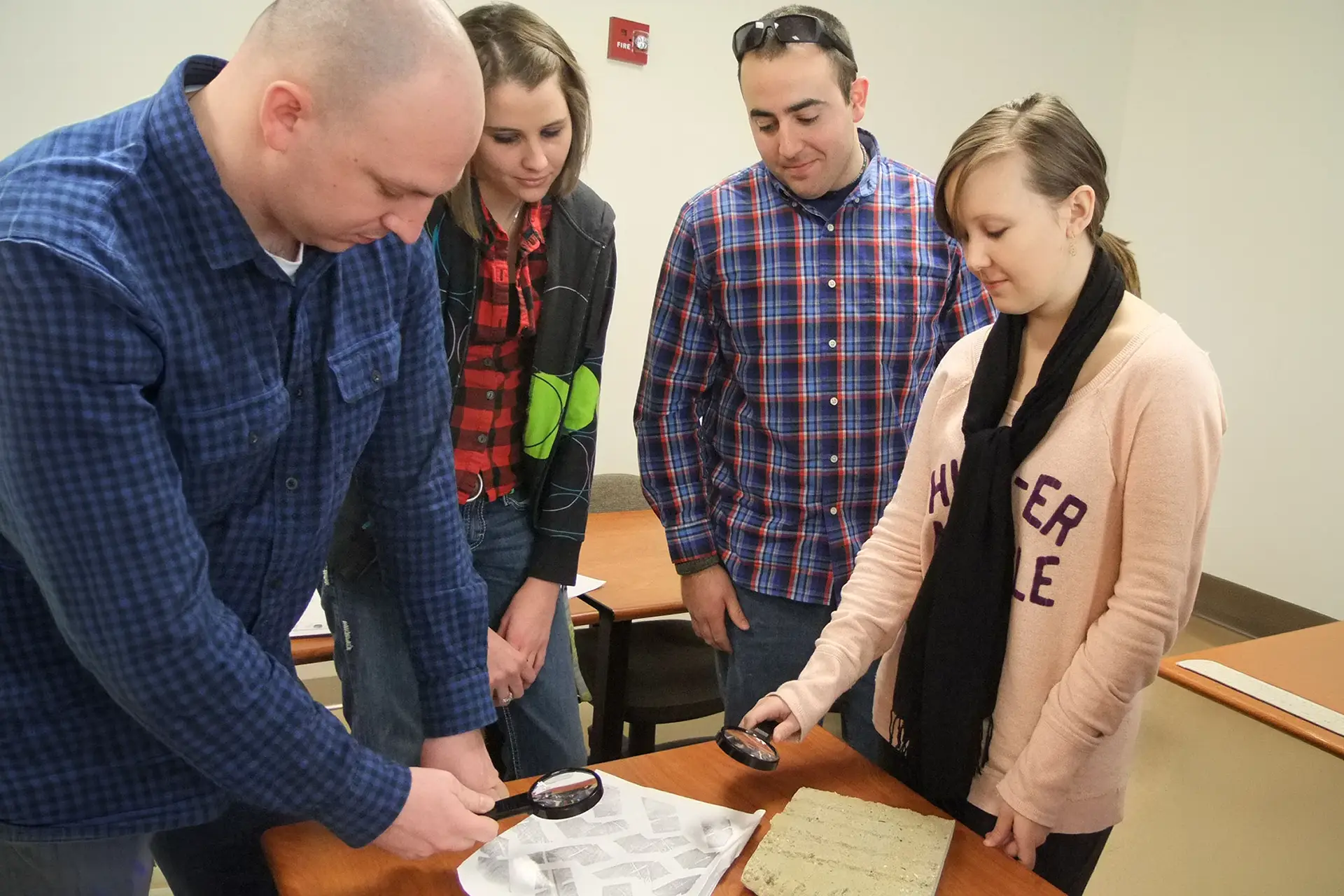
Criminal Justice Students Examining Evidence
Overview

Exploring Criminal Justice Schools in Tennessee? Build a Strong Foundation at Northeast State

If you want to prepare for entry-level criminal justice jobs or transfer to a four-year institution to earn a credential that expands your career opportunities, Northeast State Community College’s associate degree in criminal justice offers a clear path forward.

With three associate degree options to choose from, this intentionally broad program introduces you to law enforcement, courts and corrections while helping you build ethical judgment, critical thinking and communication skills that support long-term growth across a wide range of criminal justice careers.

Program Options
Associate of Arts (A.A.) · Associate of Science (A.S.) · Associate of Applied Science (A.A.S.)
Credit Hours
62
Average Time to Completion
Approx. 2 years (full-time)
Program Location
On-campus, online, hybrid
Program Start
Any term
Application Deadline
None
Why Northeast State

Why Choose Northeast State for a Criminal Justice Association Degree?

At Northeast State, you’ll experience a criminal justice program built to support both academic progress and practical planning. The associate degree in criminal justice is structured for working adults, first responders, and nontraditional students, with online, evening, and hybrid course options that fit around work and life commitments. You’ll learn in an environment that emphasizes ethical responsibility, system-wide understanding, and faculty and advising support, helping you make informed decisions about transfer or workforce preparation as you move through the program.

4 reasons making your Northeast State experience stand out

Criminal Justice System from the Inside

Our criminal justice curriculum follows a balanced, system-wide approach to public safety education. Rather than focusing on a single career track, you’re introduced to the major components of the criminal justice system — law enforcement, courts, and corrections — with real-world context that helps you develop a well-rounded perspective.

Select a Degree That Fits Your Goals

Northeast State’s criminal justice associate degree options offer multiple academic and career pathways. The associate of applied science in criminal justice provides the academic preparation you need for entry-level criminal justice jobs, while other options support continued education and transfer planning.

Clearly Sequenced Criminal Justice Curriculum

The program aligns with widely recognized academic and workforce preparation standards within the field, ensuring you understand how theory connects to practice. Coursework reflects current practices, ethical standards, and foundational knowledge expected by four-year institutions and justice-related employers.

Benefit From Faculty Guidance

Criminal justice faculty bring real-world experience into the classroom, drawing on service to their communities so you can connect coursework to professional expectations. They are accessible and create a supportive learning environment, with ongoing advising and mentorship as you prepare for transfer or criminal justice degree jobs.

Criminal Justice Program By the Numbers

Focused on Your Success

3 Degree options: A.A., A.S. and A.A.S.
2 Years Typical time to complete your degree full time
3 Core areas of study: law enforcement, courts and corrections
Programs

Criminal Justice Associate Degree Options

At Northeast State, your associate degree in criminal justice is designed to offer flexibility without locking you into a single direction. You’ll choose from three associate degree options that share foundational coursework while offering different areas of emphasis. Each option helps you understand how the criminal justice system works, with intentional course sequencing and faculty support throughout your studies. If you’re still determining your direction in the criminal justice field, our advisors and faculty will help you evaluate options and identify the degree that supports your plans to pursue criminal justice degree jobs or additional studies.

If you’ve completed a Peace Officer Standards and Training (POST)-certified Basic Police Officer Course, you may be able to earn college credit for what you’ve already learned. Through prior learning assessment (PLA), up to 15 credit hours may count toward your degree, helping you finish faster.

3 Degree Options

If you’re looking for a broad academic foundation, the Associate of Arts in criminal justice allows you to explore the criminal justice system alongside a strong general education core. You’ll study key areas such as law enforcement, courts, and corrections while building critical thinking and communication skills that support continued academic growth. As a Tennessee Transfer Pathway, this option is structured so your coursework transfers smoothly to participating four-year institutions in Tennessee, making it a strong choice if you plan to continue your education.

What to expect

  • Associate of Arts (A.A.) degree
  • On-campus, hybrid, and/or online coursework
  • Emphasis on foundational criminal justice curriculum

What you’ll study
While the core criminal justice courses are the same across the A.A. and A.S. degree options, you’ll complete more humanities and foreign language coursework in the A.A. program. This prepares you to transfer into a Bachelor of Arts program at a Tennessee college or university.

Your core criminal justice courses at Northeast State are:

  • Introduction to Criminal Justice: Examine how law enforcement, courts, and corrections work together
  • Introduction to the Legal Process: Analyze how laws are created, interpreted, and applied
  • Introduction to Law Enforcement: Explore the roles and responsibilities of policing and public safety
  • Introduction to Corrections: Study correctional systems, rehabilitation, and reentry

Not sure which degree option is right for you? An academic advisor can help you compare transfer expectations and choose the option that best supports your plans.

If you’re interested in a more analytical approach to criminal justice studies, the Associate of Science in criminal justice provides a strong academic foundation grounded in reasoning, analysis, and systems-level understanding. You’ll study key areas such as law enforcement, courts, and corrections while developing analytical skills that support upper-level coursework. As a Tennessee Transfer Pathway, this option is structured so your coursework transfers smoothly to participating four-year institutions in Tennessee.

What to expect

  • Associate of Science (A.S.) degree
  • On-campus, hybrid, and/or online coursework
  • Intentional progression through criminal justice curriculum

What you’ll study
While the core criminal justice courses are the same across the A.A. and A.S. degree options, you’ll complete more math and natural science coursework in the A.S. program. This prepares you to transfer into a Bachelor of Science program at a Tennessee college or university.

Your core criminal justice courses at Northeast State are:

  • Introduction to Criminal Justice: Examine how law enforcement, courts, and corrections work together
  • Introduction to the Legal Process: Analyze how laws are created, interpreted, and applied
  • Introduction to Law Enforcement: Explore the roles and responsibilities of policing and public safety
  • Introduction to Corrections: Study correctional systems, supervision, and rehabilitation

Unsure which degree option to choose? An academic advisor can help you compare transfer expectations and select the option that’s best for your future.

If you want to start working in criminal justice jobs after earning your associate degree at Northeast State, the Associate of Applied Science in criminal justice focuses on practical, career-oriented coursework. This option emphasizes learning how criminal justice work is done day to day, while still giving you a solid understanding of law enforcement, courts, and corrections.

What to expect

  • Associate of Applied Science degree
  • On-campus, hybrid, and/or online coursework
  • Focus on preparation for careers in criminal justice

What you’ll study
In addition to the same core criminal justice courses as the A.A. and A.S. degrees, the A.A.S. includes classes that focus on real-world practice, helping prepare you for entry-level criminal justice jobs, including:

  • Criminal Investigation: Learn how cases are examined, evidence is handled, and investigations are conducted
  • Criminal Intelligence: Study how information is gathered and analyzed to support public safety efforts
  • Juvenile Justice: Explore how the justice system works with youth and juvenile cases
  • Criminal Justice Practicum: Gain supervised experience connecting classroom learning to real work settings
  • Issues and Ethics in Criminal Justice: Examine ethical decision-making and professional responsibility

Not sure if this degree option is right for you? An academic advisor can help you compare workforce and transfer expectations and choose the option that best supports your plans.

Transfer

Plan on Transferring?

We provide personalized support.

Northeast State makes it easy to take the next step toward a bachelor's degree. Through established transfer pathways, Tennessee Transfer Pathways and articulation agreements with colleges and universities across the region, students can transfer credits with confidence and continue their education without losing momentum. Whether you're earning an associate degree or completing general education requirements, our transfer advisor provides the guidance, resources and personalized support you need to achieve a smooth and successful transfer.

Transfer Info

Admissions

How to Get Started in the Criminal Justice Program

Admission to the criminal justice degree program follows Northeast State’s standard enrollment process, with degree requirements, course sequencing, and program options outlined in the academic catalog. As one of the criminal justice schools in Tennessee, Northeast State offers structured coursework that supports both transfer and workforce goals. If you have questions about criminal justice programs or next steps, you can contact Eric Stanton at 423-354-5351 or ESStanton@NortheastState.edu, and academic advising and student support services are available to help you plan your courses and stay on track toward your education or career goals. If you’ve completed a P.O.S.T.-certified Basic Police Officer Course, ask about prior learning assessment credit for select courses.

Connect with Northeast State